|
| |
| Articles |
|
|
| Newsletter Subscription |
| Get the
inside track
on all the
hot news
regarding
DeskShare
products,
new
releases,
special
promotions
and
discounts. |
| Subscribe to our
DeskShare
News. |
|
|
| |
My Screen Recorder
v2.65
|
| |
|
| |
|
| |
Recording a Region
of Your Desktop Screen |
| |
|
| |
|
|
| |
Whether you're making a
training video, a
promotional recording,
or a movie to include in
a PowerPoint
presentation, your
screen recording has a
point to make. If
that point is in only
one part of the screen,
recording the entire
screen has two major
effects: |
|
| |
|
|
| |
- It makes the
video less
effective, by adding
distractions, and
- It makes the
final movie file
bigger, increasing
both the time
required in
downloading and
playing it, and the
cost of Internet
hosting for the
server (both for
storage and
bandwidth).
|
|
| |
My Screen Recorder
lets you choose to
record only a part of
the Windows desktop.
Using this feature, you
can produce files that
are both smaller and
communicate more
powerfully. |
|
| |
|
|
| |
 |
|
| |
|
|
| |
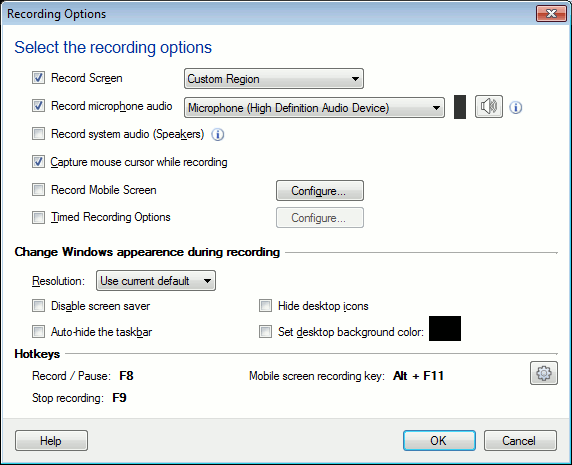
To choose how much of
the screen to record,
use the Region
feature. Your
choices are Full
Desktop, Fixed
Dimensions,
and Rectangle. |
|
| |
|
|
| |
Full Desktop
records everything that
happens on the screen.
Both Fixed Dimensions
and Rectangle
record only a part of
what's on the screen.
In fact, both record
rectangles. The
only difference is that
a Fixed Dimensions
lets you set the size
and position of the
rectangle in pixels.
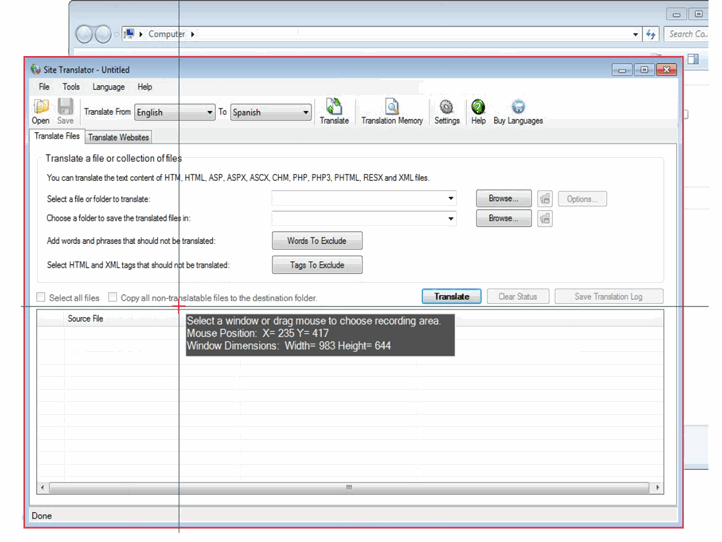
In the Rectangle
selection you select the
recorded area by
dragging the mouse. |
|
| |
|
|
| |
Which should you use?
Well, if you need to
record the activity in
several windows, or to
show complex procedures
that can only be
illustrated using a
large window, it's
probably a good idea to
record the Full
Desktop. If
you're going to
illustrate points that
can fit into a smaller
space, for instance
which options to select
on a particular dialog
box, reducing the area
recorded offers the
advantages of greater
focus and smaller file
size. |
|
| |
|
|
| |
To choose between
Fixed Dimensions
and Rectangle,
consider the final use
of the recording.
It's easier to trace a
rectangle around odd
shapes with the mouse
than to guess their size
in pixels. On the
other hand, if you're
going to distribute the
video on a DVD or VHS
tape, or combine it with
video from a digital
camera, it will greatly
simplify things if it's
recorded in a standard
pixel size. For
instance, many digital
cameras produce video in
a frame size of 640x480
pixels. If you use
Fixed Dimensions
to record video at that
same size, combining the
recording with the
digital video will be
simple and produce
good-quality output. |
|
| |
|
|
| |
Let's do an actual
recording. I'll
record the same
procedure in Microsoft®
Word, first in Full
Desktop and then in
Fixed Dimensions
mode. |
|
| |
|
|
| |
My screen resolution is
1024x768 pixels during
this recording, so that
will be the size of the
movie I'll make in the
first case (Full
Desktop). This
one minute video takes
up 4.7 megabytes of disk
space. |
|
| |
|
|
| |
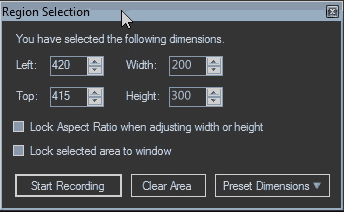
Now I record the same
video using Fixed
Dimensions. I
choose to create a
640x480 rectangle.
If I checked Fixed
starting point (see
the image given below) I
could type in a starting
point for the rectangle.
Why would a start point
specified by two numbers
be an advantage?
Well, what if you were
going to record the
movie in two parts, or
record two "takes" of
the same movie, and you
wanted them to look
exactly the same?
By using a numeric start
point, you can be sure
the Fixed Dimensions
area is in the same
place. This would
be very difficult to do
if you placed the
rectangle by dragging
the mouse. In my
case, since I'm only
doing one take here, I
will go ahead and place
the rectangle by using
the mouse. |
|
| |
|
|
| |
 |
|
| |
|
|
| |
In order to make
everything fit, I simply
resized the Word window.
Recording the same
operations in this
smaller space, the one
minute video takes up
only 2.6 megabytes.
Why does it take lesser
drive space? Well,
each frame of a 1024x768
screen recording has
786,432 pixels.
Each frame of a 640x480
movie has only 307,200
pixels. Since the
recordings I made have
the same number of
frames, the video with
smaller dimensions takes
much less drive space.
If you usually have your
screen resolution set
even higher (for
instance, 1280x960), the
difference would be even
greater. |
|
| |
|
|
| |
This illustration shows
how much more is
recorded in each frame
of the Full Desktop
movie than in a smaller
rectangle. (Both
are scaled down by the
same percentage.) |
|
| |
|
|
| |
 |
 |
|
| |
|
|
| |
If you chose to upgrade
to
My Screen Recorder Pro,
you would have two other
options to produce
smaller, more efficient
files. My Screen
Recorder Pro lets you
automatically change
screen resolution during
recording.
Also, you can
record the contents of a
single window only.
My Screen Recorder Pro
has other advanced
features, which you can
easily identify by
looking at the
comparison chart. |
|
| |
|
|
| |
Every screen recording
should be designed to
convey a particular
point. By focusing
the viewer's attention
on a smaller area,
recording from a region
can make your movies
more effective and
powerful, while creating
smaller files that are
easier for people to
work with and watch.
The fixed-size areas you
can record using
Fixed Dimensions
also make it easier to
combine your screen
recordings with video
from other sources. |
|
| |
|
|
| |
|
|