Shopping Cart | Member
Language:
  Resources  
 
 
Pages:
  
1.Welcome
2.Working With Media Files
3.Converting Media Files
4.Configure Media Files
5.Device Profiles
6.Digital Media Converter Pro Tools
 
Apply Effects
Split Media File
Create Playlist
Rip Audio CDs
Repair Media File
PSP File Manager
7.Troubleshooting
8.Settings
9.Resources
 

Digital Media Converter Pro 3.15


Digital Media Converter Pro: CD Ripping

CD Ripping

Digital Media Converter Pro can convert the sound recorded on audio CDs into digital files. 

To rip a CD, click on Tools >> Rip Audio CD or the Rip Audio CD icon in the toolbar.

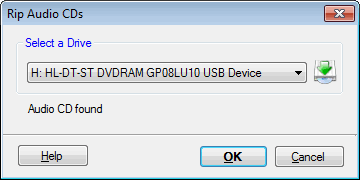
The Rip Audio CDs dialog is displayed.

Select the drive that contains the disc you wish to rip and click Next.  Depending on the type of disc in the drive, Digital Media Converter Pro will begin the CD ripping process.

CD Ripping

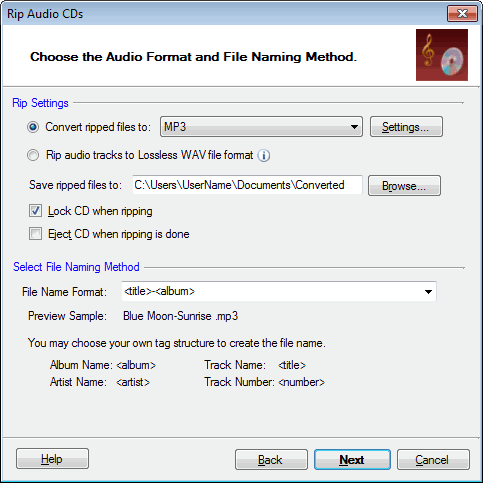
If a CD is in the selected drive, the Select File Format window appears.  Choose the Audio Format that suits your needs. 

Use File Name Format to choose how Digital Media Converter Pro names the audio files it creates.  The default setting is fine for most purposes—most personal audio players list songs by their title, not their filename, in any case.  If you choose a filename pattern that will produce the same title for several songs (for instance "<artist>"), be sure to select Force to append the Track-number so that each gets a unique name.  If you do not do this, as each track is ripped it will replace the previously-ripped track, and you will end up with only the last track.

If you select Look Up Track Information Online, Digital Media Converter Pro will contact a database over the Internet and find information like album title, song title, and artist name for each audio track.  Uncheck this if you do not have an Internet connection to save time. 

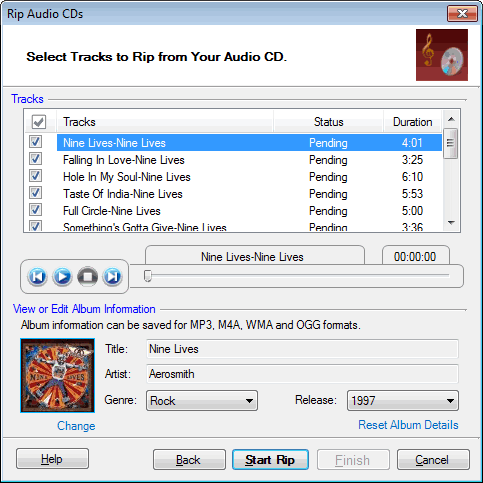
The next screen of the Wizard lets you choose tracks and a folder to save into:

By default, all the tracks are selected.  You can control which tracks are ripped by selecting or deselecting the checkboxes.  To hear a track, use the CD Preview. The four buttons are Previous track, Play/Pause, Stop, and Next track. Select a track, and use the Play button to listen to it.  This will help you decide which tracks to rip, especially for CDs not found in the CDDB, in which case the tracks are only labelled "Track 1", "Track 2", and so on.  

If digital CD playback has been disabled, this following message is displayed (message is visible in Windows 2000/XP):

Digital Media Converter Pro automatically re-enables digital playback, but you will need to restart the computer for the change to take effect and Digital Media Converter Pro to preview tracks from audio CDs.

Rip Settings tab.

If there are defective areas on a CD they can introduce noise known as jitter into the audio stream.  Jitter Correction mathematically analyzes the sound data as it is read, and corrects for these problems.  It increases the fidelity of the sound reproduction, but also slows down the ripping process.  Most CDs do not jitter, so the default is to use Jitter Correction only if errors are detected.  If you hear clicks during playback of your ripped files, you may wish to set Jitter Correction to Always for maximum correction.

The CD Drive area lets you control the behavior of the CD drive.  You can Lock CD when ripping, to prevent the drive from opening during the process, and/or Eject CD when ripping is done, which can both alert you that the process is complete and make it easier to change CDs if you are ripping several in one session.

To "normalize" audio means to reduce differences in volume.  If the tracks you are ripping have very different volume levels, it may be hard to listen to them together without adjusting the playback volume.  Choosing to Normalize the output audio tracks can solve this problem.

Most people will not need to change anything on the CDDB tab.  Change these settings only if you are having trouble communicating with the CDDB.  Experts may wish to use a different online CD database, in which case you would change the CDDB Server and CGI Script settings. The details will be explained in the documentation for the alternative database.  Ask your network administrator for assistance in setting up a network Proxy.  

Clicking Next opens the Ripping Tracks screen. Digital Media Converter Pro displays its progress as it reads tracks from the CD and converts them to WAV files. You can stop the process by pressing the Stop button.  When the process completes, press Finish.

Note that if you have not checked Look Up Track Information Online, the files will be named "01 Track 1", "02 Track 2", and so on.

After tracks are ripped, a link appears that lets you Create M3U Playlist of ripped files. Playlists are small files that tell audio players which files to play in which order.  If you would like to create a playlist, click the link. You can edit the playlist using the Playlist Editor.

The CD tracks are originally ripped as WAV files.  After ripping is complete, the WAV files are added to the conversion list, and you can convert them to the desired final format.  The WAV files also remain on your hard disk.  If space is an issue, you may want to delete them after confirming that your conversion was successful.

Note: Digital Media Converter Pro will not be able to read the Audio CDs from a USB DVD/CD drive.

Copyright © DeskShare. All rights reserved.